Who's the Best for Vendor-Neutral Archives: AWS HealthImaging vs Medicai
As a practising medical doctor for almost 18 years, I really can’t tell you how many prescriptions I’ve needed to write.
Most hospital IT teams now face the choice between AWS HealthImaging and Medicai when they need a vendor-neutral archive that works across sites without adding new on-prem hardware.
By the end of this article you will know the exact storage and retrieval limits of each option, how their integration and exchange features differ, and which pricing model fits a multi-location radiology workflow.
Quick Verdict: Medicai for Vendor-Neutral Archives
Medicai delivers a zero-footprint DICOM viewer and vendor-neutral archive that processed 1 million studies last year on HIPAA and GDPR-compliant infrastructure.
HIPAA compliance and GDPR compliance protect patient data across every transfer and storage step. These certifications meet requirements for hospitals and clinics that handle sensitive medical imaging on a daily basis.
The platform stores 1.7 million studies and supports 10,000 active doctors across 70 clinics and hospitals worldwide. Global availability allows teams in different regions to access the same medical imaging archive without local servers.
Medicai reports 50 million API transactions each year, showing reliable interoperability with existing radiology workflow systems. This level of usage supports data migration projects and multi-tenant architecture needs for growing healthcare networks.
At a glance: how Medicai compares to AWS HealthImaging on the features that matter most.
| Feature | Medicai | AWS HealthImaging |
|---|---|---|
| Vendor-Neutral Archives | ✓ | — |
What Is Medicai?
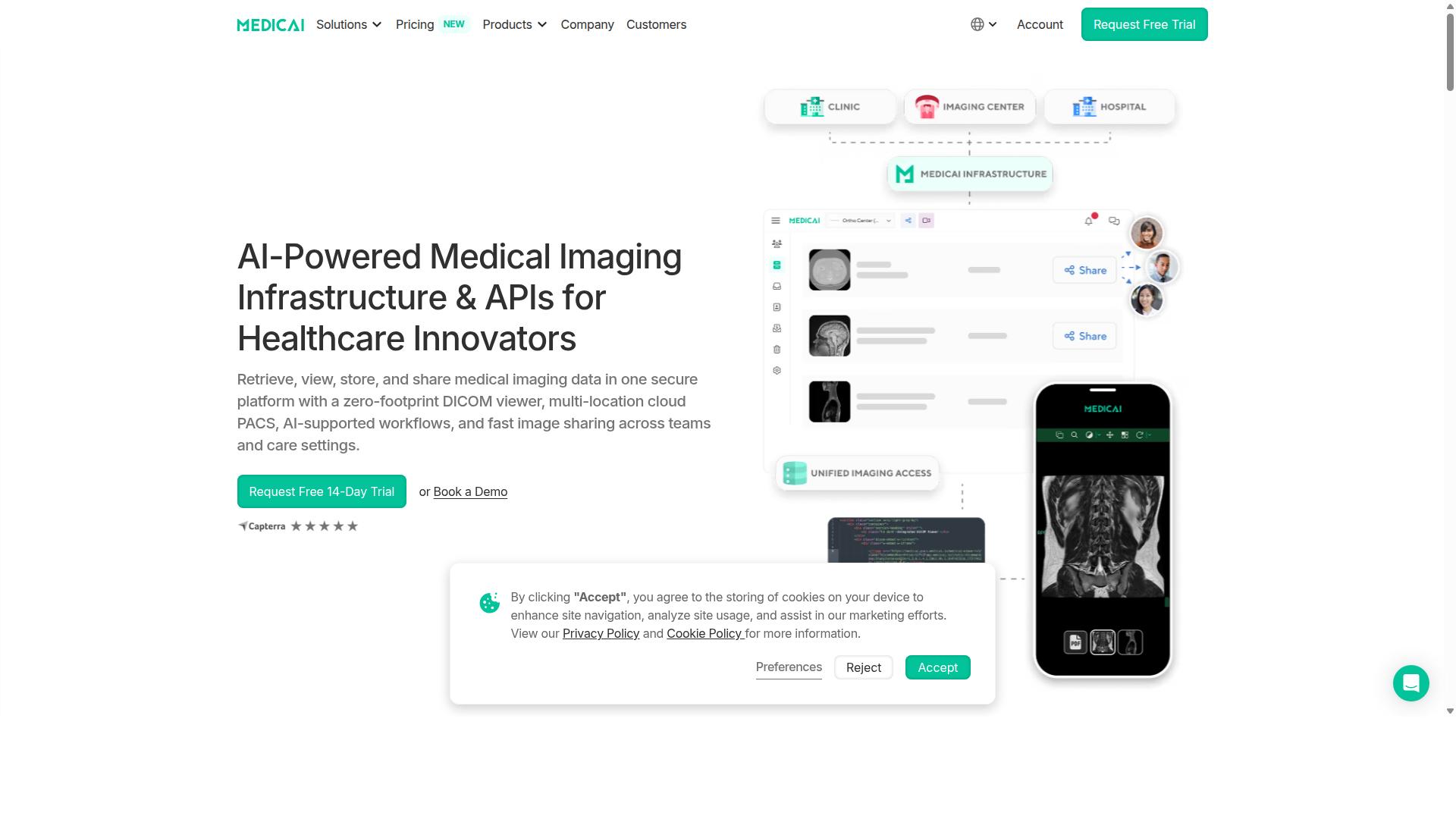
Medicai is a cloud-based medical imaging platform that retrieves, views, stores, and shares DICOM studies through a single secure workspace. This approach unifies multiple functions that traditional systems often split across separate tools.
The platform includes a zero-footprint viewer that runs directly in browsers. Users access studies from any location without installing software.
Cloud storage forms the foundation of Medicai's multi-location cloud PACS. Organizations keep imaging data in secure environments that scale based on demand rather than fixed hardware purchases.
Data exchange happens through built-in capabilities that support care teams working across different sites. This structure helps reduce delays when specialists need images from other departments or facilities.
Medicai stores over 1.7 million studies and maintains HIPAA and GDPR compliance. These standards matter for healthcare organizations that handle sensitive patient information across borders or multiple jurisdictions.
The platform functions as Imaging Infrastructure as a Service. This model shifts infrastructure management away from internal IT teams while keeping clinical workflows intact.
Interoperability remains central to the design. Care settings can exchange imaging data without forcing departments to adopt identical systems or vendors.
AI-supported workflows connect with the core platform. This allows teams to add analysis tools without rebuilding their entire imaging infrastructure.
What Is AWS HealthImaging?
AWS HealthImaging is Amazon Web Services' managed medical imaging service designed for storing, accessing, and analyzing DICOM data at scale. The platform operates as a cloud-based solution for healthcare organizations that need to manage large volumes of medical images. It supports standard DICOM protocols while running within the AWS infrastructure ecosystem.
Healthcare providers often evaluate AWS HealthImaging when considering vendor-neutral archive options for their medical imaging needs. The service handles image storage and retrieval across different healthcare settings. Organizations can access their DICOM data through standard APIs provided by the platform.
Many facilities compare AWS HealthImaging against other cloud PACS solutions when planning their medical imaging strategy. The service integrates with existing hospital systems through FHIR and HL7 standards. This compatibility supports interoperability requirements that healthcare organizations typically need.
Security features include encryption and audit logging capabilities that address HIPAA compliance concerns. The platform offers different storage tiers to help manage costs based on access frequency. Healthcare organizations can also benefit from scalability options that adjust to changing data volumes.
Some healthcare systems consider data sovereignty requirements when evaluating cloud-based medical imaging solutions. AWS HealthImaging provides deployment options across various geographic regions. Disaster recovery features help protect against data loss in critical situations.
Features Compared
A side-by-side look at how each platform handles storage, integration, security, and support reveals divergent strengths for different use cases.
Organizations evaluating vendor-neutral archive solutions need concrete details on capacity, connectivity, and compliance before making a decision.
The following sections break down storage performance, exchange capabilities, and security posture to clarify which platform aligns with specific operational requirements.
Storage & Retrieval Capabilities
Medicai's Vendor Neutral Archive and Cloud PACS provide 500 GB to 2 TB tiers, on-demand retrieval, and AWS/Azure redundancy for sub-second study access.
The platform processes 1 million studies yearly and maintains 1.7 million studies in active storage across current deployments.
AWS HealthImaging offers standard cloud storage options with typical retrieval speeds for medical imaging workloads.
Organizations with high-volume workflows often find Medicai's tiered approach matches their growth trajectory without additional infrastructure overhead.
Integration & Exchange Features
Medicai supplies REST APIs, HL7/FHIR connectors, and Medical Image Exchange to move studies across 300 thousand visualizations per year.
The system handles 50 million API transactions annually while supporting DICOM Gateway and Medical Imaging Uploader tools for inbound data.
Seventy clinics currently exchange imaging data through these standardized connectors without custom development work.
AWS HealthImaging provides general interoperability features typical of major cloud vendors for medical imaging workflows.
Teams needing structured data exchange across multiple facilities consistently select platforms with proven HL7 and FHIR support already in production.
Security, Compliance & Support
Medicai is HIPAA, GDPR, and FDA/CEE cleared with AES-256 encryption, immutable audit logs, and follows OWASP security guidelines for all components.
The platform includes Doctor Imaging Portal and Patient Imaging Portal access controls that maintain compliance across multi-tenant deployments.
Current users include ten thousand active doctors who rely on these security measures for daily clinical workflows.
AWS HealthImaging maintains standard cloud security certifications and encryption protocols expected from major infrastructure providers.
Healthcare organizations subject to strict regulatory requirements often prefer platforms with explicit FDA clearance and documented audit capabilities already validated in clinical settings.
Pricing Compared
Medicai lists Starter at $249/month for 500 GB and Standard at $749/month for 2 TB, while AWS HealthImaging uses its own pay-as-you-go model. These published tiers give organizations predictable monthly costs without calculating separate storage, retrieval, or transaction fees.
Each Medicai plan includes unlimited user accounts and no surprises at billing time. Starter supports no connected locations, while Standard adds one connected location for facilities that need on-site gateways. Enterprise customers can request custom storage and multiple external connections.
AWS HealthImaging charges depend on data volume, API calls, and retrieval frequency. Organizations often face variable monthly invoices that shift with usage patterns across their medical imaging archive and vendor-neutral archive workflows.
Medicai also offers yearly billing with 15 percent savings. Starter drops to $209 per month and Standard to $639 per month when paid annually. A 14-day trial of Starter features requires no credit card.
Teams comparing total cost of ownership must factor in setup fees. Medicai charges a one-time $1,000 per location for DICOM Gateway configuration. Per-study pricing remains available for enterprise customers who prefer usage-based arrangements.
The fixed pricing structure helps radiology departments forecast annual budgets more reliably than pay-as-you-go alternatives. When comparing vendor-neutral archive options, predictable costs support long-term planning without hidden transaction fees.
Who Should Choose Medicai
Hospitals, imaging centers, and specialty groups in orthopedics, neurology, oncology, and cardiology seeking a ready-to-deploy cloud PACS favor Medicai. These organizations often manage complex cases across multiple locations and require consistent access to imaging data without the complexity of building their own infrastructure.
Specialty care providers across radiology, ophthalmology, ob-gyn, pulmonology, dentistry, and gastroenterology also find Medicai suitable. Virtual care providers, telemedicine platforms, and teleradiology services benefit from the same platform that supports their distributed workflows and patient populations.
Organizations handling over 1M+ studies gain confidence from proven scalability. Medicai supports this volume while maintaining global access, allowing teams to retrieve images and reports across different regions without performance degradation or regional restrictions.
Personal injury lawyers, tumor boards, clinical trials, and medical education organizations represent additional user segments. These groups need reliable image sharing and collaboration features that work across different institutions and time zones.
Patients benefit through the Patient Portal feature, which provides direct access to their imaging records. This capability supports transparency requirements and improves patient engagement without requiring separate systems or portals.
Who Should Choose AWS HealthImaging
Organizations already invested in AWS infrastructure that need deep native-cloud scaling may lean toward AWS HealthImaging. These teams often manage large radiology workflows and require tight connections to other AWS services for storage and compute.
Enterprise health systems with existing AWS contracts sometimes prefer this route. Their IT departments already handle security reviews and compliance processes for the same vendor, which can simplify procurement steps.
Research institutions running AI projects on AWS may also select this option. The service integrates with tools for machine learning pipelines and large-scale data processing initiatives.
Teams focused on vendor-neutral archive requirements should consider several factors before committing. Data migration paths, ongoing management overhead, and long-term storage costs all require careful evaluation.
Organizations exploring cloud PACS alternatives often compare medical imaging archive solutions based on their current technology stack. AWS HealthImaging works best when the surrounding infrastructure already runs on the same platform.
Consider your team's technical expertise and existing vendor relationships when making this choice. Some groups find that specialized medical imaging platforms offer simpler deployment options for their specific workflows and compliance needs.
Final Verdict
Medicai's 1 M+ studies processed annually, 50 M+ API transactions, and zero-footprint viewer position it as a strong vendor-neutral option for teams prioritizing speed and compliance.
The platform combines vendor-neutral archive capabilities with HIPAA compliance and API access that medical centers need for seamless image retrieval. Research organizations benefit from the multi-tenant architecture that supports both clinical and academic workflows without adding complexity.
Starter and Standard tiers give teams flexibility when scaling DICOM storage and interoperability requirements. Organizations can begin with basic cloud PACS functions and expand to advanced FHIR integration as case volumes grow.
Medicai USA operates from 7901 4th St N, STE 300, St. Petersburg, FL, 33702 and can be reached at +1 (832) 220 1035. Medicai Romania is located at 53-55 N Filipescu, 5th Floor, Sector 2, Bucharest, 020961 with contact available at +40 316 305 875. General inquiries route through [email protected].
Recommended Resources:
